
How Chicago River Boat Tours Combine Views, History, and Design
The first time I stepped onto a Chicago river boat on an early June evening, the upper deck still warm from a long day of sun, I expected a postcard parade of skyscrapers. The skyline delivered, of course, but what stayed with me were the stories. A docent held up a photograph of a soot-darkened, low-slung warehouse where a glass tower now stands, then pointed toward a bridge whose trusses once halted a parade of prairie schooners. The water itself was the bigger surprise. It does not flow the way most people assume. On this river, engineering redirects nature, and the city has made a stage of it.
That mix of spectacle and substance is why the Chicago River cruise is not just a tourist staple. It is a crash course in how a city learns, fails, and tries again. For anyone curious about design, urban planning, or simply how to read buildings with your eyes, a boat tour distills 150 years of Chicago into 75 to 90 minutes that feel much shorter.
What the water teaches
The Chicago River looks modest from the bank, a working waterway edged with limestone, steel sheet piles, and new plantings. But this channel is the hinge on which the city swung from frontier to metropolis. In 1900, engineers completed the Sanitary and Ship Canal and reversed the river’s flow so that sewage and storm runoff moved away from Lake Michigan. That difficult, controversial project saved the city’s drinking water and opened a freight corridor to the Mississippi. You feel the consequences of that decision the moment the boat noses under the first bridge and the engines settle into a clean hum. Every bridge, warehouse, and stepped riverwalk terrace is here because Chicago forced a river to obey.
The tour makes this legible. When a guide explains why the main stem widens near Michigan Avenue, or how Wolf Point once held a trio of taverns that predated the skyline by a century, you begin to see cause and effect rather than a jumble of glass and steel. The buildings tell a civic story you can read at five miles an hour.
The classic river loop, and why it works so well
Most chicago architecture boat tours trace a similar figure. They depart near the DuSable Bridge at Michigan Avenue, head west along the main stem past Wabash, State, and Dearborn, turn north at Wolf Point toward Kinzie Street, then pivot back and dip down the South Branch to float past old rail yards and the shadow of Willis Tower. This three-pronged route compresses the city’s greatest hits and its rough edges into a compact reel: Beaux-Arts at the river mouth, early twentieth-century warehouses upriver, International Style minimalism anchored by Mies van der Rohe’s black boxes, then postmodern wit and contemporary sustainability along the renewed Riverwalk.
The tight channel creates a moving proscenium. On LaSalle Street, a perfect civic vista lines up with the Carbide & Carbon Building’s champagne-bottle crown further east. Around a bend, 333 West Wacker drapes a green glass curve that mirrors the water surface so convincingly you forget it is a facade. A block later, a docent might point at a nondescript brick building and explain that it survives from when the river held more tugs than tour boats.
There is craft in the pacing. The best tours know that you need a big moment in the first ten minutes. The Wrigley Building’s white terra cotta gives it willingly, with its clock tower receding in five stacked tiers. After that, it is about contrasts. The Gothic tracery of Tribune Tower throws the taut discipline of a Miesian curtain wall into relief. Marina City’s twin corncobs twist the eye, their pie-slice parking stalls edging into the void, then give way to Vista Tower - now called St. Regis Chicago - with its trio of stacked volumes dissolving into one another in cool blues. The effect is cumulative, not just a sequence of factoids. You feel why Chicago became a laboratory.
A city that invents and reinvents its rules
Chicago did not birth the skyscraper because it liked tall things. Fires, soil, and ambition forced invention. After 1871, the need to rebuild at speed met a swampy site that punished heavy masonry. Steel frame construction, terra cotta cladding for fire protection, and elevators combined into a recipe for height that the city refined for decades. River tours explain this, and you can watch the story evolve on either bank.
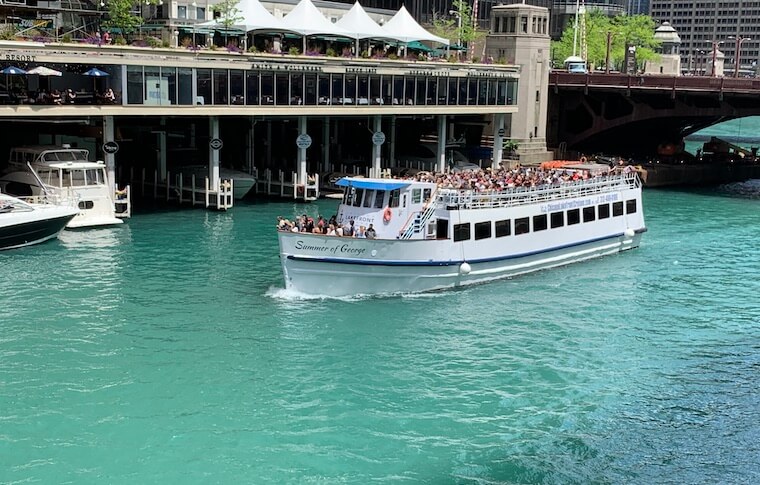
The narrative jumps forward in the 1920s with towers like the London Guarantee Building, then sets down the 1930s marker with the Merchandise Mart, a behemoth at 4 million square feet that once had its own zip code. When a docent talks about the Mart’s Art Deco rhythms and original function as a wholesale market owned by the Kennedys for a time, the scale makes sense. It sits like a mountain at a bend where the South and North Branches meet, and the river makes its bulk readable in a single glance.
The postwar years bring Mies. You can recognize his hand from the deck before the guide names him. Steel and glass, proportioned with monastic care. 330 North Wabash, once IBM Plaza, now AMA Plaza, rises as a platonic rectangle. You could lecture on the International Style, or you could drift by on a slow boat and see it. The 1970s push westward reveals structural bravado in towers that explore new ways to resist the wind. And then Chicago loops back on itself with a run of postmodern gestures that wink at the past. A docent might joke that the 1980s went rummaging in the history closet. Sometimes it works - look at 190 South LaSalle’s barrel vault - and sometimes it gets cheeky.
Lately, sustainability does the talking. Aqua undulates for a reason, its balconies catching breezes and breaking up wind vortices. St. Regis stacks volumes to cut down on bulk while opening views and optimizing daylight. The Riverwalk iterations from 2015 to 2017 did not just pretty up the bank. The designs knit together new habitats, manage stormwater, and make space for people who want a coffee close to the water without dodging a delivery truck. All of this comes alive when an expert connects dots you might miss from the street.
Bridges as moving architecture
If buildings are the actors, Chicago’s bridges are the stagehands that never stop working. The city still operates one of the world’s densest networks of movable bascule bridges. A docent will tell you the term comes from the French for seesaw, then point to a pair of monumental bridgehouses flanking Michigan Avenue, Beaux-Arts bookends that hold the counterweights and control rooms. Between April and October, you might catch a nine a.m. Bridge lift for migrating sailboats, a slow procession that halts traffic and gives pedestrians a live lesson in urban mechanics.
From the waterline, details pop. The trunnions smear with grease. The deck plates show wear from a century of tires. Even the rivets tell a story about industrial craft. Do not be surprised if your guide references the McCormick Bridgehouse & Chicago River Museum tucked into the southwest bridgehouse of the DuSable Bridge. It is one of those small civic gems the tours love to flag.
Bridges also set the rhythm of the tour. They compress your view, then release it in short bursts. A savvy captain will hold the boat between pylons to frame the Wrigley Building perfectly, or swing wide to let the light rake the green glass of 333 West Wacker as if polishing it with the river.
Comparing the tours, and why the guide matters more than the boat
You can book chicago architecture boat tours through several operators: those affiliated with the Chicago Architecture Center, Wendella, Shoreline Sightseeing, Mercury, and a few smaller lines. Most use double-deck vessels with open-air seating above and climate-controlled salons below. Prices typically range from roughly 40 to 65 dollars for adults depending on time, day, and operator. Durations run 75 to 90 minutes for the full architecture loop. Evening options add the glow of office lights along with fewer barges to dodge.
The differences lie in narration depth, route nuance, and pacing. The Chicago Architecture Center’s cruises use trained docents whose scripts evolve, and you can usually hear the years of practice in how they handle follow-up questions. Wendella and Shoreline also field strong narrators, and their schedules sometimes make it easier to snag a last-minute seat. Mercury leans friendly and family oriented. If you crave a breezier spin with a splash of speed, Seadog runs fast boats that will shave off some detail in exchange for a thrill and lake spray.
Pick a time that fits your temperament. Morning cruises bring sharper light, calmer water, and fewer party groups. Midday floods the glass with glare and heat in July, but you can tuck into the lower deck if the sun gets to you. Twilight is popular for good reason. The river smooths out, reflections sharpen, and buildings flick on, one office at a time. After dark, the narrative changes tone. Guides point to lighting schemes and crown illuminations, and the river chicago river boat ride loses its working-day grit.
Docents matter more than the boat. A guide who can explain why a building looks the boat tours chicago way it does beats one who recites dates. The best use humor without snark, and admit what they do not know. They also adjust to the best chicago boat tour crowd. I once heard a docent pivot to compare a structural truss to the undercarriage of a kid’s scooter when a family asked, then fold that image back into the main thread so no one felt left behind.
Reading the river from a seat that suits you
Boat design shapes what you see and hear. Upper decks have unobstructed sightlines for photography, but you will share them with wind and sun. Lower decks shelter you from both and still give you a full narrative via speakers, although you will miss some upward views under low bridges. Many boats let you wander, and you should. If you start near the bow and hang a bit to starboard, you will pick up the main stem’s east bank facades nicely. When the captain swings north at Wolf Point, slide across to port to keep 333 West Wacker and the Kinzie Street corridor in frame. On the South Branch, move to the stern and watch Willis Tower line up between trusses when you look back.
If you are traveling with someone who uses a mobility aid, call the operator or check the website for boarding details. Most boats handle ramps well, but not every dock has the same slope, especially at very low or very high water. Restrooms on board vary in size. If accessibility is a priority, the Architecture Center’s First Lady boats and Wendella’s larger vessels tend to be better equipped, but specifics change with refits.
A primer in styles you can spot from the water
Guides on chicago architecture boat tours do not expect you to memorize a textbook. Still, it helps to carry a few mental labels. Beaux-Arts tends to shout in limestone, symmetry, and ornaments like cartouches and pilasters. You will see it near the mouth of the river at the Wrigley Building and the Michigan Avenue bridgehouses. Art Deco tightens the belt, trading curvy leaves for chevrons and setbacks. Merchandise Mart stands as a lesson in mass and repetition.
The International Style strips away the heavy trim and elevates the glass and steel frame. Mies van der Rohe is the shorthand here: form follows function, no funny business. Postmodernism, by contrast, raids the attic for references and tucks them into contemporary buildings. It can give you delight, like 190 South LaSalle’s homage to a barrel-vaulted banking hall, or edge toward pastiche. Recent decades have favored environmental performance. Look for shading devices, high performance glazing, and planted terraces that do more than decorate.
The river is a vantage point architects use too. Jeanne Gang’s Aqua and St. Regis orient their moves to the water. Bertrand Goldberg’s Marina City pushes its petals toward the current, a residential coronation that looks like sculpture and acts like practical geometry. 333 West Wacker is a masterclass in empathy, turning its glass to hold a curved reflection of the river so that the building reads as water rather than wall.
The Riverwalk changes everything at ground level
If you last walked the riverbank before 2015, the new Riverwalk will feel like a different place. It is not one continuous boardwalk, but a series of rooms. The Marina Plaza near State lets you linger beside tour queues and watch crews coil lines. The Cove makes space for kayaks to slide past while motorboats idle. The Jetty toward Wells plants floating gardens that clean the water and give school groups a quick science lesson. You can grab a coffee and watch a tug shove a barge through a narrow arch, which teaches more about the city’s working face than any lecture.
From a boat, the Riverwalk reads as a thread sewing together mismatched edges. It relaxes the hard industrial vocabulary with steps that sit right at the water. That is not trivial. Designers had to accept more frequent flooding and plan for surfaces that would clean easily. When a docent notes the subtle grade and the material choices, you begin to respect how much engineering hides in a pleasant place to sit.
Weather, water, and the edge cases that shape your ride
Chicago weather keeps its own counsel. A July afternoon can swing from sticky heat to a cool lake breeze in fifteen minutes. On the river, the temperature often runs a few degrees lower than the street. Pack a light layer, even in August. If the sky threatens rain, tours still run. The lower decks stay dry, and in a shower the city can look more dramatic, with glass towers beading up and reflections deepening.
High water occasionally closes low-clearance bridges, which may force route changes. That rarely cancels a tour, but you might skip a branch. In spring and fall, bridge lifts for sailboat migrations can add unplanned pauses. If you are down to a tight schedule, ask at the booth about any known disruptions.
The river gets dyed bright green for St. Patrick’s Day. Tours that week carry a party atmosphere and a different narrative emphasis. On summer Wednesdays and Saturdays, fireworks at Navy Pier pair with evening cruises. That is a lovely add-on, but the finale happens on the lake, not the river, so you will split time between architecture and open water. Decide if that trade suits you.
Water quality has improved since the river ran as an industrial drain, but it remains a living urban system. You will likely see geese and gulls, sometimes herons, and in the last decade more schools of small fish near the Jetty’s plantings. The faint smell you catch near outfalls on a hot afternoon is part of the city’s metabolism, not a failure of the experience.
A few buildings to watch for, with reasons to care
Tribune Tower is more than neo-Gothic drama. Embedded in its facade are stones from landmarks around the world, some gifted, some collected with a collector’s zeal in an era before heritage laws tightened. Your guide might point to a labeled fragment from the Great Wall of China or the Parthenon. The gesture can read as hubris and curiosity at once, a snapshot of a century’s mindset.
Wrigley Building shines because of its terra cotta skin. That radiant white did not come cheap to maintain. The building underwent a significant restoration that cleaned and repaired its tiles, proof that a pretty face requires careful work behind the scenes.
Marina City, often called the corncobs, was a social experiment as much as a shape. Goldberg designed a whole city within a city with apartments, workplaces, parking, and a marina. When the tour slides past, you will spot residents tending plants on narrow semicircular balconies. It feels precarious, but the geometry is proven. No car has ever tumbled into the river, despite the famous 1960s ad that made it look possible.
333 West Wacker uses its curve as urban courtesy. It gives back a river view to everyone upriver. From the water, the building becomes a mood ring for the sky’s color. Photograph it in the morning, then again at twilight, and you will think the glass changed overnight.
St. Regis Chicago stacks three glass volumes that taper and swell to shift weight, avoid wind problems, and open up sightlines. At certain angles the seams disappear and the tower looks poured rather than assembled. It is a rare combination of engineering logic and visual grace.
How chicago architecture boat tours help you become a better city observer
A good tour does not just give you names and dates. It trains your eye. By the time you disembark, you will find yourself reading window patterns for clues about a building’s era, spotting a shift from limestone to terra cotta and knowing what that might mean, or noticing how a base meets the sidewalk and guessing at the developer’s priorities. The next day, walking Michigan Avenue, you may look up at a cornice and hear your docent’s voice unpacking the difference between ornament as structure and ornament as applied flourish.
If you return for a second tour on a different day or with a different operator, the city will re-edit itself. The narrative flexes with the guide, the weather, and construction cranes that never seem to rest for long. A temporary platform signals a facade reclad. A barge stacked with rebar turns Wolf Point into a working river again. You gain patience with mess and respect for the people who keep a complex place alive.
Quick planning checklist that saves headaches
- Book in advance for peak weekends from June through September, and choose refundable tickets if your schedule is fluid.
- Aim for morning or evening slots for better light and cooler temperatures, especially in July and August.
- Bring a light jacket or scarf even on warm days, plus sunscreen and sunglasses for the upper deck.
- If photography matters, a wide lens in the 16 to 24 mm range on full frame - or your phone’s ultra wide - captures tight bridge approaches.
- Check for special events like bridge lifts or fireworks that may alter the route or crowd levels.
Seats, sound, and sightlines
- Upper deck, forward seats are best for unobstructed views, but you will need to pivot often as the boat turns at Wolf Point and down the South Branch.
- Lower deck offers shade, shelter, and clearer narration on windy days, with trade-offs under low bridges where the upward view narrows.
- If you want symmetry shots - centered facades across the water - stake out the stern before a bend so you can shoot backward as the vista opens.
- Move when you can. Most operators allow standing along railings for short stretches, which makes a big difference in tight corridors.
Small truths that make the stories stick
Dates matter less than patterns. You do not need to remember that the Merchandise Mart opened in 1930 so much as you should understand that economic forces and new technologies create families of buildings. The moment your guide traces a line from a fire law to terra cotta cladding to the bright white of the Wrigley Building, the city’s logic becomes more than trivia.
Humor helps. Many docents puncture pretension, which is healthy in a town that reveres hard work. One I know prefaces a discussion of postmodern crowns by asking, do you like hats? By the time we glide past a pediment that looks borrowed from Rome, the group can enjoy the flourish without sniping at it.
Respect the river. The captain’s slow approach to a low bridge is not dawdling, it is seamanship. Pile up a few barges, a gust pinballing off towers, and a tour boat full of distracted people with cameras, and you need a steady hand on the throttles. When a captain threads an arch beside a tie-up where a tug sits smoking, you are watching a skill as local as a deep dish and more valuable.
When the tour ends, keep the thread going on foot
Disembarking near Michigan Avenue makes it easy to continue the lesson. Walk east to DuSable Lake Shore Drive and turn around. The river mouth frames a full-century gradient in one glance. Step down to the Riverwalk and take five minutes on a bench. You will recognize buildings you thought you had already filed away. Pop into the Bridgehouse Museum if it is open. If you still have daylight, cross the DuSable Bridge and look left for the Tribune Tower’s facade stones, each with a label that reads like a passport.
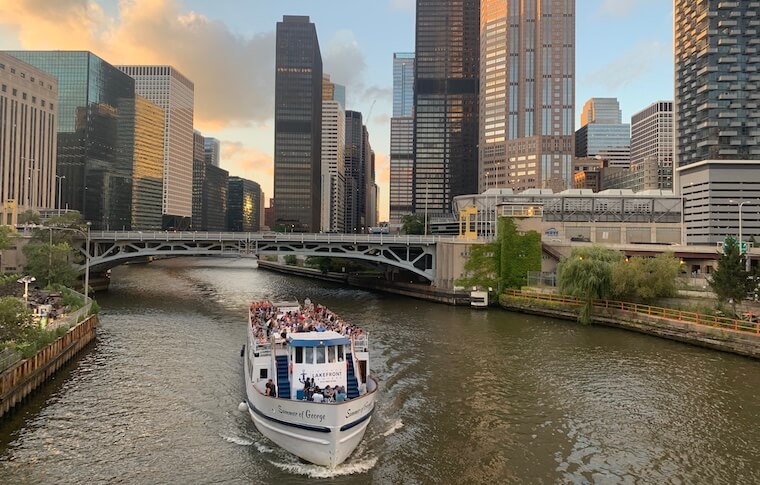
The second lap around the loop will feel different. You will start to notice how signage sits on a facade, how street furniture ducks under a colonnade, or how a lobby glows in late light. You will hear snippets from several tours at once, a friendly chorus. The story never quite repeats because the river never does. A cloud passes, a drawbridge lifts, a heron lands on a mooring, and the city edits itself in real time.
Why it endures
Plenty of cities offer skyline cruises. Chicago’s feel different because the river is inseparable from the city’s identity, an engineered artifact with the candor of a shop floor. The tours work because they stand close to that truth. They show you triumphs without hiding the costs, and they trust that a listener can handle nuance while enjoying a drink and a breeze. If you are curious about architecture, the experience sharpens your eye. If you are not, it still gives you an evening of light and water that feels earned rather than staged.
Step aboard with a layer for the wind, a few questions for the guide, and an open schedule after the dock. The river is generous company, and Chicago knows how to talk when it has the stage.
Tours & Boats Architecture Tours 900 S Wells St Chicago, IL 60607 ph: (312) 858-6955 https://toursandboats.com