Why Tribune Tower Is a Highlight on Many Chicago Architecture Tours
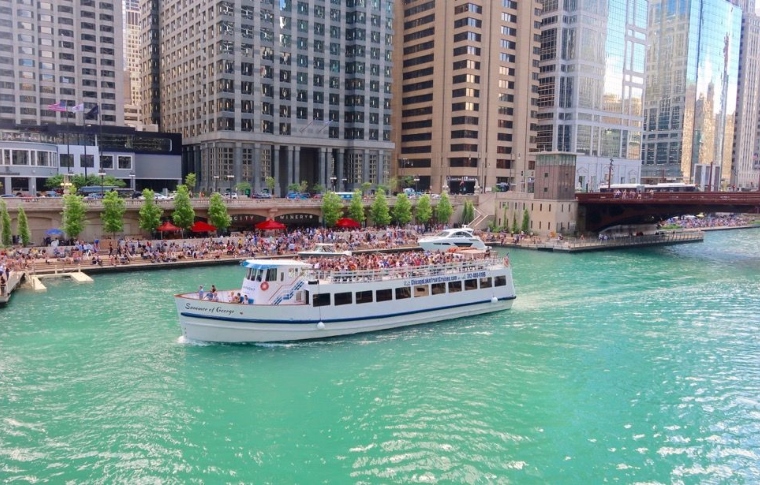
Stand on the south bank of the Chicago River at Michigan Avenue and look north. The river bends, the bridge lifts and lowers on summer weekends, and the skyline seems to stack itself like a display shelf. To the right sits the Wrigley Building in glazed white terra cotta, to the left rises a jagged crown of limestone that looks like it could have been lifted from a medieval town, then stretched into a modern high rise. That crown belongs to Tribune Tower, and it is the reason so many tours slow down, point, and linger.

For years leading groups by foot along Michigan Avenue and narrating from the deck of riverboats, I learned that Tribune Tower is the one stop that cracks the code for visitors. People may not recall the subtle setbacks of a Miesian tower, but they remember a building that literally contains pieces of Notre Dame, the Alamo, and the Great Wall. They remember a contest with hundreds of entries that turned architecture into front-page news. And they remember that Chicago does not treat its skyline like a museum of styles, but like a working library of ideas.
The contest that turned a newspaper into a landmark
In 1922, the Chicago Tribune held a competition to design its new headquarters. The paper wanted the most beautiful office building in the world, and it printed the submissions in its pages, inviting a global audience to judge along with the professional jury. More than 260 entries arrived from around 20 countries. Some were sober essays in classicism, others wild experiments. Two entries still show up in architecture textbooks: Eliel Saarinen’s rationally stepped, modern form that predicted the coming decade, and Walter Gropius and Adolf Meyer’s stark glass shaft that seemed to come from another planet.
The winners, though, were New York architects John Mead Howells and Raymond Hood. Their design married a steel-frame skyscraper to a vertical Gothic skin. It was a choice that made business sense. The Tribune needed a symbol of authority and tradition, something that telegraphed stability to readers and advertisers. Neo-Gothic, when handled with discipline, could do that while still emphasizing height and modernity. Construction began in 1923 and concluded in 1925. The finished tower rose a bit over 460 feet, around 36 stories, with flying buttresses at the crown that gave it a distinctive silhouette against the flat lake sky.
Docents love this story because it makes the tower legible. You can trace a straight line from the newspaper’s marketing instincts to the building’s profile, and from the jury’s conservative verdict to the debates that followed. For years students argued whether the Tribune chose the past over the future, a safe facade over Saarinen’s influential, but unbuilt, proposal. That argument still whispers through tours, especially when you compare Tribune Tower to the streamlined towers further west along the river.
The Gothic language on a modern frame
The first time I walked first-time visitors under the tower’s arcades, someone asked why it looked like a church trying to be tall. The question gets to the essence. Gothic was originally a structural solution for cathedrals, letting walls dissolve into windows and sending weight down through ribbing and buttresses. Howells and Hood borrowed the vertical emphasis and ornamental vocabulary, then draped it over a steel skeleton. The result is decorative, not structural, but the details are disciplined. The setbacks step gracefully, the piers and mullions form consistent rhythms, and the crown, with its openwork buttresses, gives the building its memorable finish without getting fussy.
If you stand across the street at the plaza between the Wrigley Building towers and squint, the Tribune’s crown reads as an exclamation point. At twilight, when the limestone shifts from gray to warm beige, the buttresses seem to float. From the river, especially from the open deck of one of the chicago architecture boat tours at the main branch bend, the silhouette resolves into a set of lancet forms that pull the eye up and away from the clutter below.
The base matters as much as the top. The Michigan Avenue frontage acknowledges pedestrians with deep arches, carved bosses, and inscriptions that celebrate freedom of the press. It strikes the right balance between ornament that rewards close inspection and a calm order that holds together at a distance. On tours, I ask people to read just one inscription out loud. It changes the tone of the stop, reminding everyone that this used to be a working newsroom and broadcast center, not a decorative backdrop for photos.
Stones from everywhere, and the one corner that reads like a travelogue
The famous fragments embedded in Tribune Tower’s lower walls do heavy lifting for storytellers. Reporters traveling abroad in the early 20th century gathered pieces from historic sites. Today, more than 100 stones appear along the base, each with a small metal label: a chip from the Great Pyramid, a brick from the Alamo, a piece from the Great Wall, a corner from Notre Dame de Paris, even stones tied to Mount Vernon and Westminster Abbey. People often ask if this was plunder. The story is less sensational than that. Much of the material came from debris or with local approval, often small fragments that would otherwise have gone unnoticed. Still, it raises a modern question about what counts as respectful souvenir and what edges toward exploitation. Good tours sit with that tension for a minute rather than sweeping it aside.
The fragments work because they turn the sidewalk into a tactile atlas. I once watched a family from Texas find the Alamo brick and snap a photo with surprising pride. A Parisian visitor ran a finger over the Notre Dame label, months after the 2019 fire, and shook her head with a smile. You don’t need an art history degree to feel a connection. That democratic touch is classic Chicago.
Where the river makes the tower click
On foot, Tribune Tower can feel hemmed in by traffic, retail signs, and the very successful Wrigley Building across the street. The river fixes that problem. From the water, the tower steps away from its neighbors and lets the composition breathe. Captains take it slow on the tight S-curve near DuSable Bridge, and many docents cue a small story as the bow points east and the lake breeze pushes upstream.
Different operators have slightly different angles. The Chicago Architecture Center’s vessels often pull close to the south bank where the crown lines up with the Wrigley clock tower, and you can talk about the rivalry between the two corporate neighbors. Wendella’s routes approach from slightly farther west, which gives a longer view where Tribune’s setbacks align with the rhythm of the bridgehouses. Shoreline’s boats sometimes pause just long enough to let you compare Tribune’s carved limestone against the streamlined, lighter-toned 333 North Michigan. The point in all cases is that the river unlocks the layering that makes this stretch the city’s best outdoor architecture classroom.
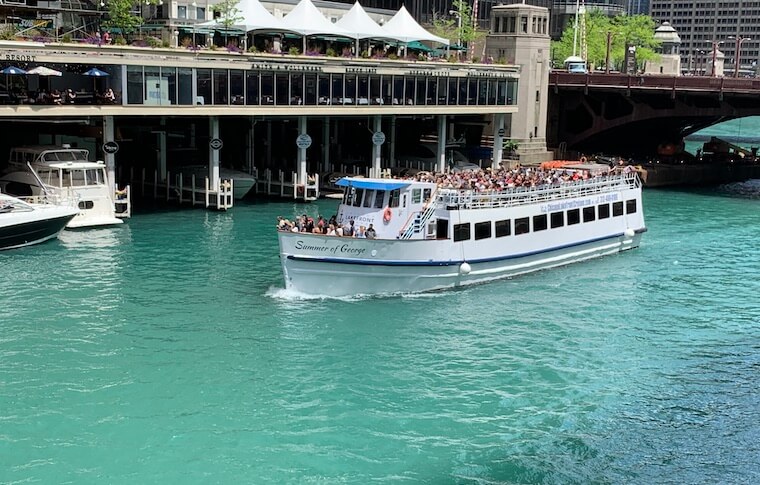
Because the river is a working corridor, no two passes are identical. On windy afternoons the current can push you off your mark, so a good docent trims the story to fit the window of the sightline. At dusk in summer, lights pop on in stages. The Wrigley glows first, then the subtle uplighting on Tribune’s crown wakes up. I have had tours fall silent for half a minute during that shift, without any theatrical trick from the guide. The composition makes its own case.
A headquarters that became a home
For most of the 20th century, Tribune Tower was exactly what its inscriptions promised: the headquarters of a media empire. Reporters hustled through the lobby, WGN broadcast an entire radio era from studios within, and the paper’s editorial voice loomed over local politics. That lively use boat cruises in chicago showed in small ways a visitor might miss. Newsroom lights burned odd hours, and you would see a spill of paper coffee cups in the arcades at five in the morning.
Around 2018, after the company moved, the building began its conversion into high-end residences under a development team led by CIM Group and Golub. The transformation finished in the early 2020s, with the former offices becoming condominiums and amenities layered into the old chicago river tour service zones. Purists worried about the loss of an active public institution. Others argued that saving the building with new uses was better than letting a vacant tower decline. From a preservation standpoint, the project kept the facade and crown exquisitely intact and, crucially, maintained the fragments at street level. The lobby, while no longer a newsroom passageway, still presents itself as a dignified threshold. Access is more controlled now. If you want a casual look inside, you’ll have better luck during public events or open house weekends. For most visitors, the exterior remains the main stage.
I remember one fall morning during the conversion, when construction fencing channeled pedestrians into a narrow path. A retired pressman paused by the Arc de Triomphe fragment with a friend and told a story about running proofs through the night before a mayoral election. That kind of human patina is harder to catch now that the building’s daily life is private. But it lingers if you know where to look.
What boat guides tend to emphasize, and why it works
River docents do not have much time at any one stop. By the clock, you might get 90 to 120 seconds with Tribune Tower in full view before a turn or a wake interrupts. So the best tours pick two or three needles to thread. Over hundreds of runs, I heard variations on a few themes that consistently landed:
- The competition narrative that situates Tribune in a global moment and sets up a comparison to modernist neighbors.
- The fragment wall as a physical storybook that turns lofty history into sidewalk-scale detail.
- The silhouette at the crown, especially how the buttresses keep your eye climbing, as a lesson in how ornament can serve clarity.
- The building’s dialogue with the Wrigley Building across the street, a quick way to talk about rivalry, marketing, and material choices on Michigan Avenue.
- The adaptive reuse from newsroom to residences, which nudges a conversation about what it takes to keep old buildings alive.
In the time it takes to float past two bridgehouses, you can cover identity, aesthetics, and utility. That density is what tour operators crave. Not every stop offers so many layers without asking the audience for deep background.
Street, bridge, or boat: the vantage points that pay off
If you only see Tribune Tower from the sidewalk, you risk missing the big picture. The street view gives rich texture, but it flattens the massing and collapses the vertical lines. Step onto DuSable Bridge and lean on the rail for half a minute. The full height opens up, and the buttresses at the crown detach from the bulk, which makes the composition read as intended. For photographs, late afternoon from the south bank delivers the best contrast. Morning light can be flat on the Michigan Avenue side, especially in winter when the sun skims low and reflections off neighboring glass introduce glare.
The river, though, is the gold-standard perspective, which is why many chicago architecture boat tours treat this stretch as a slow scene change. Even on a crowded deck, you can usually steal a spot along the rail near midship, where the captain’s adjustments cause the least motion. If you want the crown framed cleanly against sky, station yourself on the port side as you head toward the lake. The building stacks beautifully from that angle, and the Wrigley clock tower slips into the left of the frame for scale. On the return, consider the starboard rail between Michigan and Columbus bridges. You will see how the Tribune’s mass converses with the more streamlined Art Deco neighbors, a useful comparison if you enjoy tracing style shifts in stone.
Materials, craft, and the way age helps
Limestone weathers differently than terra cotta or glass. Over a century, Tribune Tower’s skin has picked up a light patina that acts like a soft-focus lens. Ornamental carving that might have read as busy when fresh now feels settled into the mass. Chicago’s freeze-thaw cycle can be cruel, but careful maintenance has kept the facade from going blotchy. The conversion to residences gave conservators the budget to address spalls and clean staining in a restrained way. On a bright day after rain, you can see subtle tonal differences between replacement pieces and original stone, almost like a quilt. Some guides avoid pointing that out for fear of puncturing the illusion. I find it deepens the story. Buildings live, and their surfaces tell on them.
The craft goes beyond carving. Look closely at the metalwork in the entry and at the older window systems on lower floors, where shallow reveals and dark frames set up strong shadows. These small decisions keep the facade legible when the sun is high and flat. Compare that to some late 20th century projects where uniform glass dulls everything at noon. Tribune Tower’s designers understood that Chicago’s light is often cool and diffuse. They designed for shadow.
The company it keeps, and how context adds value
Architecture tours rarely evaluate buildings in isolation. Tribune Tower benefits from one of the best neighbors’ galleries anywhere. The Wrigley Building, a textbook of terra cotta glaze and Beaux-Arts organization, sits just across Michigan Avenue. The two in dialogue let a guide talk about material, corporate branding, and ideas of elegance in the 1920s. Step west and you catch 333 North Michigan, a crisp Art Deco tower with setbacks that march to a different rhythm. Downriver, Marina City’s scalloped cylinders break the rectangular grid entirely. Upriver, Mies van der Rohe’s legacy shows up in black steel and glass where ornament is taboo. In that company, Tribune Tower’s historical costume feels less like nostalgia and more like one voice in a chorus.
When I first started guiding, I worried that people would see the Gothic skin and assume Chicago was stuck in the past in the 1920s. The remedy is to point at the frame. The tower is as modern in its bones as anything of its era. The costume is communicative, not structural. That split is a very Chicago move. The city has always been comfortable with industry under the hood and poetry on the finish.
How different tours frame the same landmark
Operators tune their scripts to their audiences. The Chicago Architecture Center’s docent corps tends to be deeper on architectural history and urban context, so their narration about Tribune Tower often weaves the competition into wider trends. Private charters sometimes focus more on anecdotes and celebrity sightings. Kids’ programs lean hard into the fragments, which is a smart way to ground abstraction in something you can touch.
The hour of the day matters too. Morning runs have cleaner air and fewer boats, so the story stretches a bit. Evening cruises layer atmosphere on top, but wakes stack up and the river gets choppy, which compresses the half-minute windows where a building holds still in view. I have cut short a favorite line about Eliel Saarinen more than once to make room for the captain’s safety announcement or to acknowledge a siren on Michigan Avenue. Guides who thrive learn to edit on the fly and trust the building to do some of the talking.
Practical ways to get the most out of a pass by Tribune Tower
- For street-level detail, walk the east and south sides slowly and read at least a half dozen fragment labels. Let one stone send you home to look up a place you do not know.
- For the skyline read, grab the bridge rail on the river’s south side and wait for traffic noise to ebb. Thirty quiet seconds changes what you see.
- On the river, claim a rail spot early, and if you have a camera, set exposure for the limestone so the crown does not blow out against the sky.
- If your schedule allows, see it twice in one day, once in bright light and once at dusk. The crown’s silhouette shifts character in a way photographs do not fully capture.
- If you are choosing among chicago architecture boat tours, pick one that includes both an eastbound and westbound pass by Michigan Avenue. Two angles are better than one.
These small tactics do not require special access, just attention. They sharpen what the tower already offers.
What Tribune Tower says about the city that built it
In a city known for structural bravura and functional clarity, a Gothic-clad newsroom might seem like an outlier. Spend an hour nearby, and it becomes a lens for the rest of downtown. You see how commerce funds ambition, how competitions shape taste, and how a building can gather stories at its base as well as at its peak. You also see trade-offs. The conversion to residences kept a great facade alive but made an old gathering place more private. The fragment wall invites a sense of global belonging while asking quiet questions about ownership and memory. The crown celebrates vertical aspiration even as it decorates a steel frame that did not need such buttresses to stand.
On boats, I have heard a dozen languages at once while we float past the tower. Someone always gasps softly when the sun hits the limestone just right. The sound is not about nostalgia. It is recognition. Tribune Tower feels familiar to anyone who has seen a European cathedral, yet it is unmistakably a product of 20th century Chicago. That blend is why tours keep returning, why docents save a little extra enthusiasm for this bend in the river, and why the building rewards patience no matter how many times you pass.
It also reminds us that beauty in a city does not always come from novelty. In a skyline that keeps retooling itself, the pieces that last are the ones that hold multiple truths at once. Tribune Tower is earnest and theatrical, conservative in costume and modern in bones. It was built for a loud newspaper, then refitted for quiet living. It sits across from a pristine corporate tower and looks entirely at ease. For a guide trying to explain Chicago in a few stolen minutes between bridges, that is as good a teacher as you can ask for.
A personal note from the rail
On a late September evening a few years back, a cool wind came down the river as our boat nosed past Michigan Avenue. The tour had been noisy, football weekend and an extra party on the upper deck. As we cleared the bridge, the floodlights on Tribune Tower’s crown clicked on. The noise dimmed a notch without any cue from me. People just looked up. I kept my voice low and pointed out the buttresses, the rhythm of the piers, the way the crown opens to the sky. A kid near the bow said, not quite whispering, that it looked like a stone firework. That is not an architect’s term, but it is better. When a building can make a ten-year-old see sparks in stone, it has earned its place on any tour.
That moment is architecture tour repeatable if you give yourself the right angle and a little time. Tribune Tower does not demand you decode it. It invites you. The river gives you the space to say yes.
Tours & Boats Architecture Tours 900 S Wells St Chicago, IL 60607 ph: (312) 858-6955 https://toursandboats.com